
Understanding SLS technology: how it works, steps, applications, advantages, and limitations
A part emerges from an SLS 3D printer as if from a block of powder. Nothing supports it, no visible scaffolding, only a solid form hidden within a bed of fine material. This is one of the great advantages of this technology: it allows the fabrication of complex objects without support structures.
Selective Laser Sintering (SLS) technology is one of the most widely used 3D printing methods for producing solid prototypes, small production runs, and certain final parts. It is based on a principle that is simple to understand but very precise to master: a laser heats a powder until its particles bond together, layer by layer.

The principle of SLS is based on a powder and a laser.
Selective Laser Sintering (SLS) belongs to the family of powder bed fusion additive manufacturing processes. Unlike a filament-based 3D printer, which deposits molten material through a nozzle, an SLS machine works with a vat filled with powder. This powder becomes the raw material for the part.
The general operation follows a logic repeated hundreds or thousands of times:
A thin layer of powder is spread onto a platform.
A laser traces the shape of the part onto this layer.
The heated particles bond together.
The platform descends slightly.
A new layer of powder is deposited.
The cycle starts again until the complete object is formed.
The term "sintering" refers to the process of bonding particles together using heat, without necessarily completely liquefying the material as in conventional casting. In the case of polymers used in SLS, the material can reach a state very close to local melting. The grains soften, bond together, and create a solid zone.
The powder not reached by the laser remains in place. It surrounds the part during printing and acts as a natural support. This makes possible internal shapes, channels, integrated hinges, or perforated structures that would be much more difficult to produce with other methods.
The most common materials are polymer powders, particularly polyamide , often called nylon. PA12 is very widespread because it offers a good balance between strength, precision, and stability. PA11, powders filled with fibers or glass beads, and flexible materials such as certain TPUs are also available. For metals, similar processes are often discussed, such as laser powder bed fusion, but SLS is primarily associated with engineering plastics.
The steps in the SLS process go far beyond printing.
The success of an SLS part depends not only on the laser. It relies on a whole chain of preparation, adjustment, cooling, and finishing. Each step influences the final quality.
Preparing the digital model
It all starts with a 3D file. The part is designed in CAD software, then exported in a machine-readable format. The file is then prepared by slicing software.
This software slices the model into very thin layers. It also calculates the path the laser must follow. In an SLS machine, the operator can place several parts within the same build volume. This is often referred to as nesting or filling the build tray. Because the powder supports the objects, it is possible to stack the parts in the available space, provided the necessary distances between them are maintained.
This step has a direct impact on cost and time. A full bin makes better use of the machine and reduces wasted space.
Preparing the powder
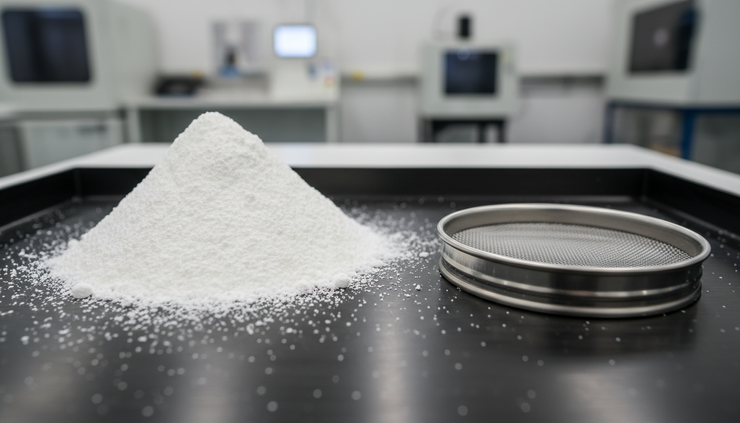
The powder must be clean, dry, and uniform. If it contains too much moisture or clumped grains, the quality can suffer. The parts may then exhibit surface defects, less consistent strength, or poorly bonded areas.
Before printing, the powder may be sifted. In many workshops, some of the unsintered powder is recovered after manufacturing and then mixed with fresh powder. This mixing process must be carefully monitored, as excessively aged powder can change its behavior under heat.
Particle size also matters. Fine grains enhance detail, but they must remain easy to spread. Powder that is too uneven results in less uniform layers.
Preheating the room
The machine heats the entire manufacturing volume to a temperature close to the point where the powder begins to bind. This preheating is essential. It reduces the energy required from the laser and limits thermal stress.
If the temperature difference between the laser-treated areas and the rest of the powder is too great, the parts can warp. Thermal control is therefore one of the most critical aspects of SLS.
The passage of the laser and the fusion of particles
Once the layer of powder is spread, the laser begins to move. It does not scan the entire surface randomly. It precisely follows the contours and solid areas defined in the digital file.
In polymer processing machines, the laser is often a CO₂ laser. It delivers concentrated energy to the powder. The particles absorb this energy, heat up rapidly, and bond to their neighbors. The machine controls several parameters:
The power of the laser
The scanning speed
The gap between two passages
The thickness of the layers
The temperature of the powder bed
These settings must be appropriate for the material. Insufficient energy results in poor sintering, making the part brittle or porous. Excessive energy can burn the material, round off details, or cause deformation.
Cooling and extraction of parts
When printing is complete, the parts don't eject immediately. The powder block needs to cool slowly. This phase may seem passive, but it protects the geometry of the parts. Cooling too quickly increases the risk of warping.
After cooling, the operator removes the "cake," that is, the volume of powder containing the parts. The objects are then removed manually or with appropriate equipment. The loose powder is collected, and the parts are then depowdered.
The finishing touches after manufacturing
A raw SLS part often has a slightly grainy surface. Depending on the intended use, it can be used as is or finished:
Microblasting to improve surface appearance
Dye to obtain a uniform color
Polishing or chemical smoothing depending on the material
Local machining for precise functional surfaces
Insertion of threaded elements or metal shafts
These finishes allow you to go from a raw technical part to a component ready to be assembled.
SLS applications affect many sectors
SLS has become the standard in professional 3D printing because it produces strong, functional, and support-free parts. It's not just for making models; it plays a role in design, testing, production, and maintenance.
Functional prototyping
Design offices use SLS to test shapes, assemblies, and mechanisms. A part made of SLS-coated nylon can be screwed, clipped, manipulated, and mounted in a prototype. It withstands testing better than a purely visual model.
For example, a manufacturer can print a casing, handle, or hinge to check ergonomics before launching an injection mold. This reduces back-and-forth and helps detect problems earlier.
Small batch manufacturing
SLS is well-suited for limited production runs. When only a few dozen or a few hundred parts are needed, creating a mold can be too expensive or time-consuming. Additive manufacturing then allows for the direct production of the parts.
This approach is useful for custom components, technical accessories, replacement parts, or niche products. It also helps maintain flexible production without storing large volumes.
Production tools and aids
In industry, SLS also produces jigs, control supports, drilling guides, and protective covers. These items are not always visible in the final product, but they facilitate work in the workshop.
A lightweight and strong SLS part can replace a heavier machined component. It can also incorporate shapes adapted to a specific workstation.

The medical, transport and consumer goods sectors
In the medical field, SLS can be used to produce orthotics, anatomical models, or components tailored to an individual. These applications require specific materials and validation processes, but the ability to personalize remains a major advantage.
In transportation, technology is used to create prototypes of conduits, supports, housings, or lightweight parts. In consumer goods, it allows for testing glasses, accessories, cases, or parts with shapes that are difficult to mold.
SLS is also advantageous for internal geometries. Channel networks, lattices, or lightweight structures can reduce mass without eliminating all strength.
The advantages of SLS technology are tangible.
SLS technology is appealing because it combines freedom of form with mechanical performance. Its benefits are not theoretical; they are evident in the way it is designed and produced.
Great geometric freedom
The powder supports the piece, eliminating the need for most supports and allowing for complex shapes.
Batch production
Several parts can be placed in the same volume, making small batch production efficient.
Good repeatability
With controlled parameters, the technology delivers consistent results from batch to batch.
Functional parts
Materials such as nylon make it possible to obtain components that are resistant, flexible depending on the case and suitable for testing.
Fewer assemblies
A part can incorporate clips, hinges, housings, channels or internal structures from the design stage.
No support to remove
Post-processing focuses mainly on dust removal and finishing.
Design freedom is undoubtedly the best-known advantage. It allows a part to be designed for its function rather than for the constraints of a mold or cutting tool. This doesn't mean that anything goes without rules. Minimum thicknesses, assembly clearances, and powder evacuation must be considered in advance.
SLS also helps to reduce certain steps. A part that would have required several assembled components can sometimes be printed in a single step. This can simplify maintenance and limit potential weak points.
The limitations of SLS must be taken seriously
SLS is not the ideal solution for all projects. It offers many possibilities, but it also imposes technical, economic, and practical constraints.
The first limitation concerns the surface finish. A raw SLS part does not have the smooth finish of a part injection-molded in a polished mold. Its texture is fine, but grainy. For parts that are visible or handled by customers, additional finishing may be necessary.
Accuracy is good, but it depends on the geometry, material, and cooling. Large, flat parts can warp. Thin areas can be brittle. Very tight tolerances sometimes require machining after printing.
Cycle time is also a factor to consider. Printing can be lengthy, and then cooling adds further delays. For a single part, this is often acceptable. For very large volumes, plastic injection molding is generally more suitable once the mold cost has been amortized.
Powder handling requires meticulous attention to detail. It must be stored, sieved, and carefully mixed, and operators must be protected from dust inhalation. Professional machines utilize systems designed for this purpose, but the work environment must remain controlled.
Finally, the choice of materials remains more limited than in other manufacturing processes. Nylon covers many needs, but it does not replace all engineering plastics or all metals.

When to choose SLS for a manufacturing project
SLS is a good choice when the part needs to be functional, complex, and produced in small to medium quantities. It is particularly relevant if supports would be problematic with other 3D printing technologies.
It is well suited to projects that require:
Complex or internal geometries
Solid parts made of technical polymer
Prototypes close to the final use
Small batches without molds
Custom components
Lightweight workshop tools
It is less suitable if the main need is a very smooth surface straight from the machine, a very low cost in very large series or a specific material not available in SLS powder.
The right approach is to start with the end use. Does the part need to withstand impacts, bending, heat, humidity, or repeated friction? Does it need to be aesthetically pleasing, precise, lightweight, waterproof, or flexible? These questions will guide the choice of material, technology, and finish.
SLS truly shines when integrated from the design stage. A part simply copied from a drawing intended for machining doesn't always take full advantage of the process. By rethinking shapes, recesses, assemblies, and integrated functions, it becomes possible to create a lighter, simpler, and sometimes more efficient part.
SLS technology is therefore neither a laboratory curiosity nor a magic bullet. It is a powerful industrial tool, based on a clear idea: transforming powder into a solid object using a precise laser. When used correctly, it opens up very useful options for prototyping, manufacturing, and customizing parts. The best results come from a balance between design, material, machine setup, and finishing.


Comments