.png)
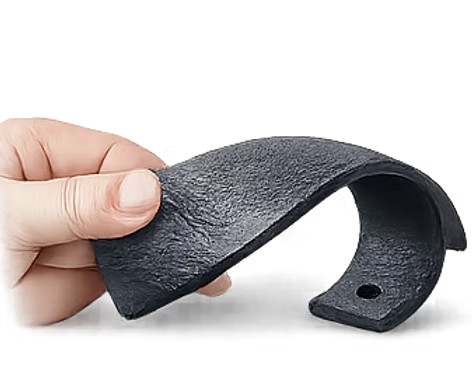
TPU
(Thermoplastic Polyurethane)
TPU (Thermoplastic Polyurethane) is THE material for flexible 3D printing. Elastic, shock-resistant and abrasion-resistant, it allows the production of parts that stretch, compress and return to their shape -- like rubber, but 3D printed.
TPU is ideal for seals, shockproof protective cases, custom insoles, anti-slip grips, wearable accessories, and any components requiring vibration absorption.
At O&D 3D Printing, we use TPU for projects where flexibility is a functional constraint, particularly in robotics, industrial protection and custom accessories.
USE CASE — WHAT FOR?
Seals and gaskets
Shockproof cases and protectors
Custom insoles and soles
Non-slip handles and coatings
Vibration dampers and buffers
Wearable and sports accessories


TPU: the flexible filament for strong and flexible 3D prints
TPU is a material particularly valued in the field of 3D printing for its flexibility and strength. Unlike traditional rigid filaments, TPU filament allows the production of flexible, elastic parts capable of absorbing shocks, making it an ideal choice for many technical and functional applications.
Thanks to its specific mechanical properties, TPU for 3D printing is widely used for manufacturing seals, protectors, soles, shock-absorbing parts, shells, anti-vibration elements, and other components requiring a degree of flexibility. Its ability to return to its original shape after deformation makes it a particularly attractive material for parts subjected to repeated stress.
TPU for 3D printing combines flexibility, wear resistance, and good durability. It also offers excellent impact and abrasion resistance, making it possible to produce parts suitable for heavy-duty use or environments requiring better impact absorption.
Available in various hardnesses and finishes, TPU can meet a wide range of needs, from highly flexible parts to more rigid components while maintaining a degree of elasticity. This versatility makes it a popular material for both functional prototyping and the production of custom technical parts.
At O&D 3D Printing , we regularly use high-quality TPU for manufacturing flexible and technical parts requiring strength, flexibility, and durability. This material is particularly well-suited to projects demanding vibration absorption, good mechanical resistance, and excellent long-term performance.
While TPU offers numerous advantages, its flexibility requires greater precision and specific settings for printing. The choice of material always depends on the mechanical constraints and performance requirements of each project.
Choosing a professional TPU filament allows you to obtain flexible, resistant 3D prints perfectly suited to modern technical applications requiring flexibility and robustness.