.png)

PETG
(Polyethylene Terephthalate Glycol)
PETG is the perfect compromise material. It combines the ease of printing of PLA with significantly superior mechanical and chemical resistance. Moisture-resistant and flexible without breaking, it stands out as the ideal choice for everyday functional parts.
With a thermal resistance around 80 degrees C, good shock resistance and excellent basic chemical resistance, PETG is suitable for many intermediate applications: housings, supports, replacement parts, food containers (depending on filament quality).
At O&D 3D Printing, we recommend PETG for any project requiring a durable part without resorting to complex technical materials like ABS or PC.
USE CASE — WHAT FOR?
Protective cases and covers
Functional supports and fixings
Common replacement parts
Containers and storage
Semi-technical functional prototypes
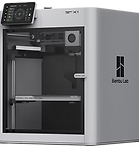


PETG: a versatile and durable filament for 3D printing
PETG is an essential material in the world of 3D printing . Recognized for its versatility, strength, and superior resistance compared to PLA, it is widely used by both professionals and users seeking more durable parts suited to technical applications.
PETG filament combines several highly sought-after advantages in additive manufacturing: good mechanical strength, excellent layer adhesion, and superior resistance to humidity and temperature variations. Thanks to these properties, it is an excellent choice for manufacturing functional parts, technical components, supports, enclosures, and everyday items.
One of the major advantages of PETG for 3D printing is its balance between ease of printing and technical performance. Stronger than PLA while remaining more printable than some industrial materials, it allows for the production of solid parts with a high-quality finish.
PETG for 3D printing is also valued for its slight flexibility and good impact resistance, which reduces the risk of breakage in parts subjected to moderate mechanical stress. Its moisture resistance also makes it an attractive material for certain applications in humid environments or moderate outdoor use.
Available in a wide range of colors and finishes, PETG allows for the production of both technical parts and visually appealing creations. Certain variants offer translucent, matte, or technical effects suited to specific prototyping and functional manufacturing needs.
At O&D 3D Printing , we regularly use high-quality PETG for the production of technical parts, functional components, and projects requiring greater mechanical and thermal resistance than PLA. Its versatility and reliability make it a particularly popular material for professional applications and demanding projects.
While PETG offers many advantages, it requires more precise printing settings than PLA and can generate more filament during printing depending on the parameters used. Therefore, the choice of material always depends on the technical, mechanical, and environmental constraints of the project.
Choosing a professional PETG filament allows you to obtain stronger, more durable prints suitable for a wide range of applications in modern 3D printing.